Media City, the world-renowned experimental film festival that is probably still under the radar for most Windsorites, is changing its schedule. The festival, which celebrates its 20th anniversary this year, moves from the spring to a mid-summer date. Perhaps because of that and the fact the festival is adding another day, “we considered it would be beneficial to give ourselves more time” for organizing, according to festival co-producers Jeremy Rigby and Oona Mosna. It’s hard to believe but this event has been taking place since 1994. Experimental film might not be everyone’s cup of tea. But in filmmaking circles the event has cred and has put little old Windsor on the international map. Every year it attracts filmmakers and audience members from around the world. The producers said another reason for moving the festival to July is because of scheduling conflicts. “Late May jammed us up a bit with a few other events that also happen in the spring,” they said. “Moving to July gives us a solid month of distance and that's beneficial for both practical reasons and for our identity.” The switch will be permanent. Media City will be held July 8 – 12.
Saturday, January 25, 2014
Sunday, January 19, 2014
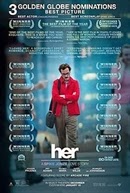
Believable look at love in the future
Spike Jonze’s Her is interesting from the POV that so much of its subject matter is relevant to the present. Theodore Twombley’s (Joaquin Phoenix) world is set slightly in the future where instead of play station screens your living room becomes a hologram, and where you advise your computer through ear buds to check email and what’s trending on your favourite websites. Not a stretch - people talk into their Bluetooth today. Socially the values of the present seem very much the same, with talk denigrating carbs and Theodore complimented for his metrosexual (i.e., female) values. Los Angeles also is dominated by Asians to such an extent that English takes second place on signs. But other things don’t seem so real. The cityscape looks like Shanghai, an agglomeration of alienating high rises and unlimited concrete. I thought we were moving to a more decentralized and “green” world. This is a trap filmmakers fall into. Jonze didn’t have to use skyscrapers to reinforce anomie. But where the movie excels is the story line and superb acting. Phoenix is a standout as usual. And Scarlett Johansson as the disembodied computer voice is as real as if you could see her on screen, which is the point. Twombley falls in love with Samantha, the voice of his new operating system. (Get ready for the future, folks, when software will have enough intelligence to mimic real persons with thoughts and feelings.) Twombley, recently divorced, lonely and disconnected, warms to this virtual person who seems to like and understand him. Their love affair is believable. The story takes the present version of dating a few notches further. We can already date through websites and have our first connections by text messaging. And there have always been physical objects to substitute for the real. But Samantha is also jealous and even dispatches a real person Isabella (Portia Doubleday) as a surrogate to improve their relationship. Otherwise she acts exactly like someone in a real love affair with all the sweet talk, sexual sighs, and insecure moments of any paramour. In the end the sadness stems from the fact this object of desire cannot be real. She breaks down and tells Theodore she has 641 lovers just like him.
Friday, January 10, 2014
A drought at the cinemas ... until, until
I was all ready to write a post about how there’s absolutely nothing of interest at the local bijoux to take myself to this week or next. 47 Ronin? Japanese historical adventure flicks don’t turn me on. The Hobbit: The Desolation of Smaug: I’ve never been a fan of these fantastical worlds not even in book form. Frozen is for kids even if it’s the “coolest” comedy-adventure and after this week’s Arctic blast who needs “eternal winter?” The Hunger Games: Catching Fire is part of what I consider a rip off (see Dec. 15 post) and likely inferior to the original as only a North American teenage classic can be. The Secret Life of Walter Mitty has more potential. Based on James Thurber’s famous short story it stars Ben Stiller, whom I’m getting a bit tired of. I think the 1947 version with Danny Kaye is likely a lot funnier. Danny Kaye was truly hilarious, not like today's comedians. Paranormal Activity: The Marked Ones? Ho-hum. Horror films are usually mediocre. And Rotten Tomatoes' 39 per cent approval just confirms that. Ok, I saw Anchorman and it was funny enough. But Anchorman 2: The Legend Continues? Perhaps it’s just me but I’m tired of the 1970's even send-ups of said decade. Which brings me to American Hustle, which has been getting pretty good reviews. But I don’t want to see 1970's era outrageous shirts, fluffy hair and wide collar jackets, and I’ve increasingly soured on period movies. There’s Grudge Match, also getting fair reviews. But this is a movie about has-beens starring has-beens, which seems to be the only role Robert De Niro gets these days. Sad. There’s Lone Survivor, a kind of Band of Brothers featuring Navy SEALs stuck in the Hindu Kush. Been there, done that if only through news headlines. If I was a kid I’d like Walking With Dinosaurs. If I had kids I’d probably take them to see it. Saving Mr. Banks is about the making of Disney’s Mary Poppins, so why didn’t they call it that? It has respectable Emma Thompson and Tom Banks but do I really want to see a movie about this? There’s The Wolf of Wall Street. It’s promising and directed by the respectable Martin Scorsese. But it’s this decade’s version of The Bonfire of the Vanities. And I’m so tired of movies attacking Wall Street and what (rich) filmmakers believe the American way of capitalism.
And then, and then, I open the online newspaper today and what do I see? I almost fell over when I saw three decent films opening ALL IN ONE WEEKEND AND ALL IN WINDSOR. It’s positively unheard of, at least in recent years at the big boxes!….. There’s Spike Jonze’s Her, featuring Joaquin Phoenix and current flavour of the month Amy Adams. Now this is a movie I could sink my virtual teeth into since it’s about a man’s over the top love affair with our increasingly over the top hi tech world. And Phoenix is in it, worth seeing for that reason alone. ….Also, there’s Inside Llewyn Davis by the Coens but which I already saw in Detroit (Dec. 23 post), and August: Osage County, with the star-stunning cast led by Meryl Streep but which strikes as a tour de force of family anger and angst, and so I will probably take a pass, thank you very much.
Tuesday, December 31, 2013
It's a wonderful New Year's movie
There are numerous “old Hollywood” movies where, from a modern standpoint, you wonder, how come they don’t make ‘em like that anymore? They’re wholesome but not in a namby-pamby antiseptic way. They exude the best human ideals, are optimistic, show the power of persistence and good humour to overcome obstacles, and make the viewer feel uplifted and trusting in his fellow man. Movies like It’s a Wonderful Life and Mr. Smith Goes to Washington come to mind. But the one I saw recently was Made for Each Other. And wouldn’t you know it, like those two other films, this one stars America’s most optimistic in character actor, Jimmy Stewart. In the 1939 film by John Cromwell Carole Lombard plays opposite as Stewart’s wife Jane. Stewart is John, a young lawyer trying to make partner in a New York law firm. As so often happens in these heartwarming comedies our hero meets adversity at every turn. He has a domineering live-in mother (Lucile Watson) who disapproves of his quick marriage to Jane, whom he met on a business trip to Boston. Their honeymoon to Europe is sidelined when an important court case is rescheduled. Hoping that winning the case will grant him partnership a smarmy colleague is chosen instead. John, a shy guy, is pushed by Jane to seek a raise. He’s up all night plotting his strategy. With determination the next day he marches into his boss’s office only to be pre-empted when Judge Doolittle (Charles Coburn) tells him the Depression has taken its toll and the firm must cut salaries. “We’ll always be together no matter what happens,” John says to Jane as the bills pile up. Then the couple’s newborn gets sick and can only be saved by a rare serum available on the other side of the country. A harrowing plane ride from Utah through winter storms finally delivers the medicine. And all turns out well. The film takes place around New Year’s Eve. A nightclub party welcomes in 1939, an ominous year if ever there was one, though the filmmakers may not have known that. “Happy New Year, darling!” And a most appropriate movie to welcome in 2014.
The more wired our world becomes the more we can't escape the electronic eye, whether it be the NSA or your friendly retail website. But I've never felt so closely watched as on Netflix. After subscribing a couple of months ago I got an email one day gently telling me that they noticed that I'd been watching movies on my computer screen. They politely reminded me that I can watch movies on television as well (duh!) and provide ways to connect an HDMI cable depending on the type of flat screen I own. (Problem is, no connection functions well with my TV, as the Netflix feed always times out.) Netflix of course also quickly informs the subscriber of their movie-watching tastes and suggests similar film titles. But this was a bit much.
Monday, December 23, 2013
Melancholy portrait of down and out folkie
So Inside Llewyn Davis, which I’d been dying to see all fall, is good – very good in fact – but didn’t quite peak out at the range I might have been expecting. The movie chronicles one artist in New York’s early 1960s folk scene just before the arrival of its most famous denizen, Bob Dylan. In reality this is a pretty straight forward character portrait of an individual who happens to be a folk singer. Supposedly loosely based on musicians like Ramblin’ Jack Elliott and Dave Van Ronk whose memoir 'The Mayor of MacDougal Street' was used for some scene setting, Inside Llewyn Davis pretty much captures the feel of the period but more the day to day travails of a struggling artist, who has no money and is forced to sleep on friends’ and acquaintances’ couches. Oscar Isaac as Lleywn Davis is superb with utterly no signs of self-consciousness for the up-close depiction of a musician off and on the stage, and he’s a great singer! Isaac sings live in the film as does one of his musician friends, Jim Berkey played by Justin Timberlake. There is little to fault in this picture. The fact it was made by the Coens, who have never made a bad film and are among the most interesting filmmakers for their topic and plot selections, pretty much seals the deal before you even walk into the theatre. If there’s anything that’s a Coens’ trademark it’s irony. But there wasn’t much here unless it’s in John Goodman’s character Roland Turner, as a gross full-of-himself burnt out jazz artist who incessantly dumps on the folk genre – and Davis - during an interminable car ride to Chicago. It’s been said the movie has no plot but it has one, just one that’s not deeply gouged out. The period’s bleak winter New York scenes are good, though the film is typically confined to indoor shots or tight street scenes and I always suspect the same vintage cars are used over and over; some of these old beaters’ doors squeaked a little too much. This could be a movie about innumerable artists of any period who have significant talent but for one reason or another – lack of contacts, bad personalities, no lucky breakthroughs – can’t get enough traction. In the end we’re sad for Davis whose career is bookended by another walk-on talent at the Gaslight CafĂ©. You know the guy, he has frizzy hair and plays a harmonica.
Sunday, December 15, 2013
America copies Asia
Hmmm. A story where teenagers are forced to fight each other to the death until only one remains. A wildly popular movie. Yeah, it’s called The Hunger Games franchise. Only it’s a rip off. Or at least that’s how it seems to me. Because over the past year I saw an entirely different movie, called Battle Royale (2000) (picture left) and directed by Japan’s legendary and now deceased director Kinji Fukasaku, based on a novel by Koushun Takami. It’s has exactly the same theme as THG. I haven’t seen any of two The Hunger Games movies, based on the Suzanne Collins novels, and who says she created the theme from several sources including Greek mythology. Nor do I want to see them. But a few critics have compared the first movie unfavourably to the Fukasaku film. And I’m not surprised. And while The Hunger Games (2012 directed by Gary Ross, THG Catching Fire, now playing, by Francis Lawrence) might scare Millennial audiences I’d be really surprised if they have the terrifying impact of an Asian real life thriller, which combined innocence, banality, pop culture and terror in a way that really sent shivers down my back.....Then we come to Spike Lee’s latest movie Old Boy. Where have I seen that title before? Sure enough, another Asian film, this time from South Korea’s Park Chan-wook in 2003, in turn based on a Japanese manga comic. I’ve seen this movie. While I can imagine Lee putting an interesting spin on the subject matter – about a bad guy who escapes a long detainment into a continuing world of violence and revenge - I still can’t imagine it being as fiercely violent and soul-searching as the earlier movie.
Monday, December 9, 2013
Movie appropriately nuanced
There’s a lot to like in Philomena, UK director Stephen Frears new movie based on a book by Martin Sixsmith. Judi Dench as Philomena is near perfect as a very Catholic elderly Irish woman who goes on a search for her long lost son. Steve Coogan (The Trip, 2010, A Cock and Bull Story (2005) and myriad other film and TV credits including Curb Your Enthusiasm, and who co-wrote and produced this movie) plays journalist Sixsmith in a not too bad portrayal of a skeptical snobbish journalist trying to get back on his feet after being sacked as a top government spokesthingy. The story’s core is about how, in the 1950s, pregnant teenager girls would be sent to “the nunnery” and their children would be sold to willing parents, often Americans. The girls, of course, had no say in the matter. Philomena wants to find her son Anthony, taken away at age three. Sixsmith does a little investigative work and finds that Anthony grew up in America to become a lawyer and eventual top advisor in the 1980s to President Ronald Reagan. Anthony, whose name was changed to Michael A. Hess, was also gay. The story takes Philomena and Sixsmith to America where most of their search takes place. To say this movie is charming misses the point. To say this movie is an overly serious condemnation of the Roman Catholic Church isn’t right either. What’s best about the movie is that it’s nuanced, a bit surprising for contemporary directors telling a story like this. Yes, we see the horror of how girls were treated in an Irish convent many years ago. But for me the real story was about professional arrogance – on the Sixsmith character’s part – and how a supposed simple woman like Philomena has more wisdom than an educated elitist. It’s also about forgiveness and not holding grudges despite righteous indignation. For good character portraits and for those lessons alone the movie is worth going to see.
Subscribe to:
Posts (Atom)


